| ☀ Revival Studio THE PIONEER LETTER / FOR GROWN-UPS | |
Medicine & life sciences The physician who made room for doubtAbū Bakr al-Rāzī | |
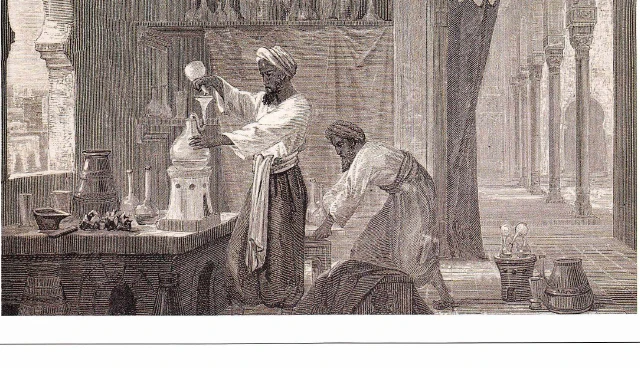 An illustration of al-Razi at work in a laboratory. From 1001 Inventions, printed page 91. Historical illustration; not a verified likeness. | |
What should a physician do when experience does not fit a respected book? Abū Bakr al-Rāzī made that tension part of his work. A Persian physician and author active around the turn of the tenth century, he worked in a medical world shaped by earlier Greek writing. His story opens a larger question for us as parents: how can we teach children to respect knowledge while still asking how we know? 01 A tradition worth questioningGalen’s writings had enormous authority in medicine. They included explanations of health and illness in terms of bodily humors. Al-Rāzī studied this inheritance, but also challenged aspects of it in Doubts About Galen. The useful distinction is between learning an explanation and treating it as untouchable. His criticism belonged to an ongoing medical conversation across languages and generations. It does not mean that he abandoned every older idea or possessed the knowledge of a modern physician. [1] [4] 02 Observation becomes a responsibilityThe research archive describes his clinical account of smallpox and measles, and his leadership in hospitals in Ray and Baghdad. Attention to differences between illnesses mattered: a familiar label could conceal different patterns in patients. Lost Islamic History also describes his commitment to continuing study and to treating poor patients without charge. Here, intellectual curiosity and service meet. Learning more was connected to caring better for the person in front of him, including someone unable to pay. [4] [2] 03 From the bedside to the laboratoryHis interests extended beyond medicine. 1001 Inventions discusses his laboratory work and descriptions of processes including distillation and crystallization. Distillation separates substances through evaporation and condensation; crystallization produces a solid with an ordered structure from a solution or melt. These processes invite close attention to materials, conditions, and changes. Their place in his writing helps us see a scholar moving between practical techniques and explanations, rather than fitting neatly into one modern school subject. [3] 04 Ideas travel further than their authorsThe archive follows his medical writing into Latin translation and European teaching. That journey matters as much as an isolated list of discoveries. Translators, readers, teachers, and critics helped knowledge circulate and change. Al-Rāzī’s legacy offers an example of scholarship as a shared, revisable undertaking. Appreciating it does not require calling one person the inventor of all modern medicine, or treating historical treatments as advice for today. [4] [5] For a family, the lasting habit is disciplined curiosity: ask what was observed, how it supports an explanation, and what might change our minds. This is our reflection on the history, rather than a quotation from al-Rāzī. | |
| |
Make this discovery theirs.Turn these ideas into a color poster for ages 7–9 or a bedtime story to share. Change the age on the site, add your own direction, and make something to print or keep. Create a poster →Make a bedtime story →Still curious? Ask a follow-up question, explore the sources, or start a live audio discussion with the guide about Abū Bakr al-Rāzī. Explore with the guide →Reading is free. Sign in to create resources or start a discussion. | |
Follow the sources1. Lost Islamic History · printed p. 86 2. Lost Islamic History · printed p. 87 3. 1001 Inventions · printed p. 91 4. Islamic Scientific Heritage · clinical medicine and legacy 5. Islamic Scientific Heritage · al-Ḥāwī and translation Book page references and the original research are collected on the pioneer’s page. | |
| A little wonder, delivered at your pace. You can choose to receive this letter by subscribing in Revival Studio.Revival Studio · Sample letter |